

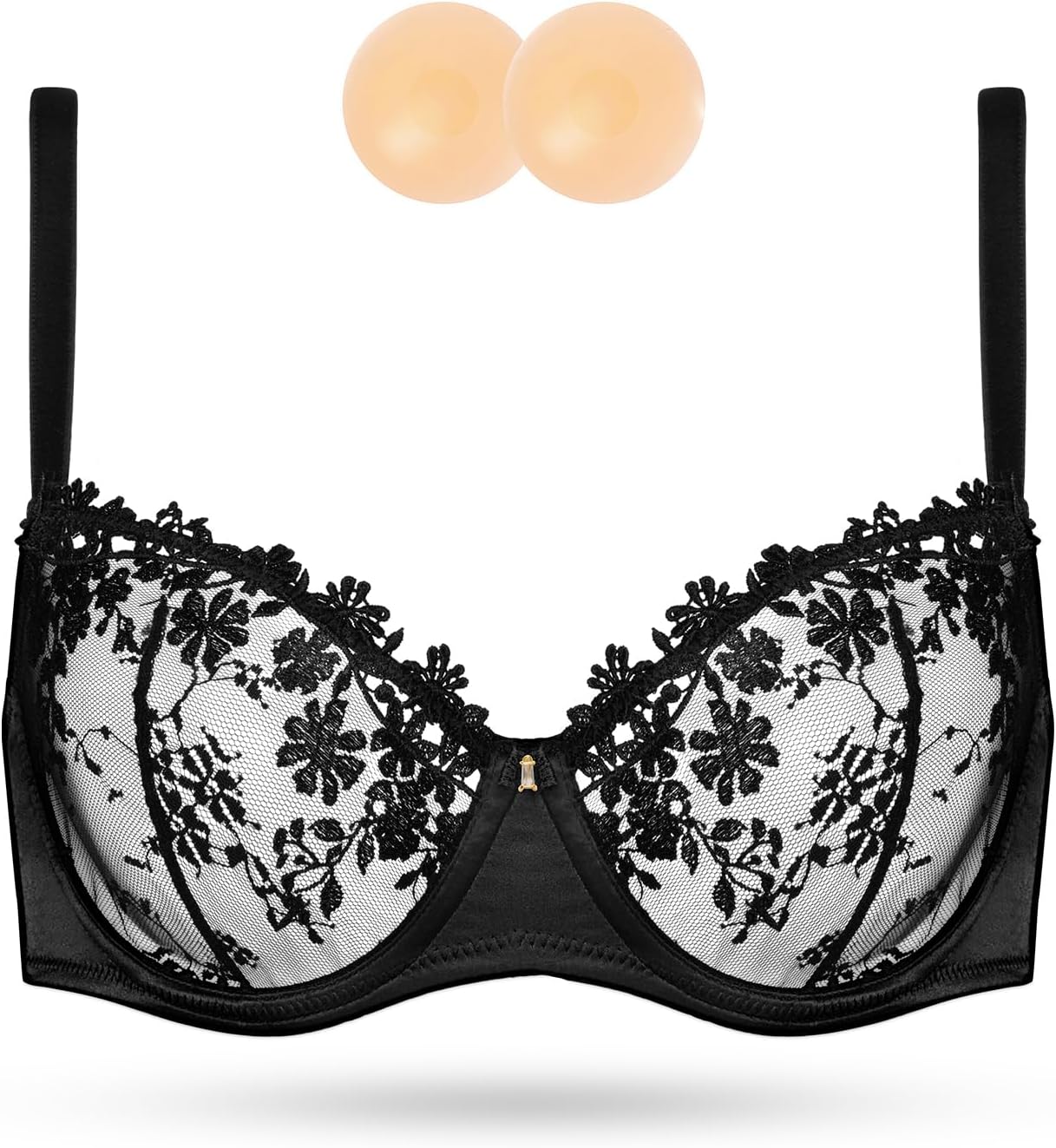


Womens Lingerie Fit Guide: How to Choose Lace, Underwire, and Garter Sets with Confidence

The most beautiful lingerie can quickly become the least-worn piece in your wardrobe if the fit pinches, shifts, gaps, or requires constant adjustment. Choosing Womens Lingerie successfully starts with understanding how the bra, briefs, and decorative pieces should work together on your body—not simply how they look.
A coordinated lace underwire bra, panty, thong, and garter-style set is a useful example because it combines several fit points in one outfit. Evaluating each component separately makes it much easier to find a set that feels comfortable while creating the coordinated silhouette you want.
Start With the Bra Because It Anchors the Set
With an underwire lingerie set, the bra is the logical starting point. A visually striking lace pattern cannot compensate for a band that rides upward, cups that do not accommodate the breasts properly, or wires that repeatedly irritate the skin.
When trying on an underwire bra, check several areas:
The band should sit relatively level around your torso rather than climbing dramatically up your back.
Breasts should sit inside the cups without obvious overflow or substantial empty space.
Straps should feel secure without doing all the supporting work.
Underwires should not painfully dig, pinch, or repeatedly rub your skin.
Your breathing and normal upper-body movement should remain comfortable.
Fit is personal, so a size that works well in one design may not produce an identical fit in another. Cup shape, band construction, stretch, and the placement of the underwire can all change how a bra feels.
Persistent redness, itching, or irritation deserves attention rather than being dismissed as an unavoidable part of wearing lingerie. Cleveland Clinic notes that tight clothing, irritation, and certain bra components can contribute to breast-area skin discomfort; persistent or severe symptoms warrant medical evaluation. Cleveland Clinic
Evaluate a Coordinated Set Piece by Piece
Consider a lace set containing an underwire bra, panty, thong, and garter styling. Although these pieces share a coordinated appearance, each interacts with a different part of the body and therefore has its own fit requirements.
The bra needs to accommodate the bust and rib cage. The panty or thong needs to remain comfortably positioned at the waist and hips, while a garter element should sit securely without excessive digging, twisting, or slipping.
This creates a practical fitting sequence:
Fit the bra and check the band, cups, straps, and underwire.
Check the panty or thong while standing, sitting, and walking.
Position the garter component and check whether it remains stable.
Put on the complete ensemble and repeat normal movements.
Decide whether you could comfortably wear it for the length of time you have in mind.
This final movement test is important. Something that appears perfectly fitted while standing still may behave quite differently after sitting down or walking around the room.
Understand What Lace Changes
Lace contributes texture, transparency, pattern, and visual detail, but "lace" alone does not tell you exactly how a garment will behave. Different lace constructions can vary considerably in stretch, softness, thickness, and resilience.
Pay particular attention to lace where it meets sensitive areas of the body. Decorative edges around the underarms, thighs, waist, or bra band may feel completely different after several hours than they do during a brief fitting.
The FTC requires most textile and wool products to disclose fiber content, among other labeling information. Reading that information can therefore give you a better understanding of what the garment is actually made from rather than relying only on its appearance. Federal Trade Commission
Think About the Occasion Before Choosing the Style
There is no single lingerie construction that is ideal for every situation. The best choice depends partly on what you expect the garment to do.
For example, a coordinated lace underwire bra, panty, thong, and garter set prioritizes a deliberately styled, multi-piece appearance. Someone choosing lingerie primarily for extended everyday wear might place greater emphasis on simpler construction, smooth surfaces, easy movement, and compatibility with outer clothing.
Ask yourself:
How long do I expect to wear it?
Will I be sitting for an extended period?
Will it be worn underneath fitted clothing?
Do I prefer substantial bust structure or minimal structure?
Am I comfortable wearing an underwire?
Is the garter component important to the look, or would I prefer fewer pieces?
These questions turn lingerie selection from a purely visual decision into a practical one.
Do a Five-Minute Fit Test
A fitting room mirror provides only part of the answer. Before deciding that a set fits, spend several minutes moving naturally in it.
Raise your arms overhead. Sit down, bend gently, walk around, and rotate your torso from side to side.
Then check whether the band has migrated, the cups have shifted, the straps are slipping, the waistband is rolling, or decorative components have twisted. A set that stays comfortably positioned through these movements is generally more promising than one requiring repeated adjustments.
Imagine two shoppers trying the same lace underwire style. One looks great while standing but experiences wire pressure when sitting; the other discovers that the bra remains comfortable but the garter section continually shifts.
Their solutions should be different. The first should reconsider bra fit or construction, while the second may simply need a different garter fit or configuration.
Never Guess About Washing Instructions
Lace, elastic, molded components, underwires, and decorative details can make lingerie more complex to care for than a basic cotton garment. That does not mean every lingerie piece should automatically be hand-washed or treated according to one universal rule.
Instead, follow the specific care label.
The Federal Trade Commission's Care Labeling Rule requires covered textile apparel to provide regular care instructions, including appropriate washing or dry-cleaning information. Those instructions are intended to tell consumers how the particular garment can be cared for without substantial harm. FTC Care Labeling Rule
Care symbols may address washing method, water temperature, bleaching, drying, ironing, and dry cleaning. The FTC provides a useful chart explaining commonly encountered garment-care symbols. FTC Care Symbols Guide
Know When Discomfort Is Telling You Something
There is a meaningful difference between a garment feeling structured and one causing pain. Underwire pressure, severe digging, persistent itching, pronounced chafing, or recurring skin irritation should not simply be accepted for the sake of appearance.
First check the obvious variables: band fit, cup fit, strap adjustment, seams, elastic edges, and whether a particular fabric or laundry product may be irritating your skin.
If irritation continues after the likely trigger is removed—or symptoms are severe—Cleveland Clinic recommends consulting a healthcare provider. Cleveland Clinic
Build Your Own Lingerie Fit Checklist
The most useful approach to Womens Lingerie is surprisingly simple: judge the garment by how well it fits your body, purpose, and comfort expectations rather than by appearance alone.
For a lace underwire bra, panty, thong, and garter ensemble, check the bra first, evaluate every additional component independently, and then test the complete set while moving. Read the fiber and care labels before deciding how the garment should be washed.
A successful lingerie choice should not require you to spend the evening thinking about your lingerie. Once dressed, you should be able to move on with whatever you planned to do.
Sources
Federal Trade Commission — Apparel and Labeling
Federal Trade Commission — Care Labeling Rule
Federal Trade Commission — Care Symbols Guide
Cleveland Clinic — Itchy Breasts: Causes and What to Do
LuckeLadybug
Noticias
How to Plan a Seamless Trip to Your Final Destination Without Travel Friction


